Wednesday, January 18, 2006

Business Trends for Future

Business in today’s world is undergoing paradigm change and every year industry has seen changes in the factors having critical impact of nature of Business. Companies struggle hard to come in terms with the fast pace of change happening in the world of business. Customer taste, loyalty, technology and economic factors undergo rapid changes within very short span of time. Mckinsey has come up with list of Top 10 trends which are likely to have major impact in 2006.


Macroeconomic trends

1. Centers of economic activity will shift profoundly, not just globally, but also regionally.

2. Public-sector activities will balloon, making productivity gains essential. The unprecedented aging of populations across the developed world will call for new levels of efficiency and creativity from the public sector.

3. The consumer landscape will change and expand significantly. Almost a billion new consumers will enter the global marketplace in the next decade as economic growth in emerging markets pushes them beyond the threshold level of $5,000 in annual household income—a point when people generally begin to spend on discretionary goods.

Social and environmental trends

4. Technological connectivity will transform the way people live and interact. The technology revolution has been just that. Yet we are at the early, not mature, stage of this revolution. Individuals, public sectors, and businesses are learning how to make the best use of IT in designing processes and in developing and accessing knowledge. New developments in fields such as biotechnology, laser technology, and nanotechnology are moving well beyond the realm of products and services.

5. The battlefield for talent will shift. Ongoing shifts in labor and talent will be far more profound than the widely observed migration of jobs to low-wage countries. The shift to knowledge-intensive industries highlights the importance and scarcity of well-trained talent. The 33 million university-educated young professionals in developing countries is more than double the number in developed ones.

6. The role and behavior of big business will come under increasingly sharp scrutiny. As businesses expand their global reach, and as the economic demands on the environment intensify, the level of societal suspicion about big business is likely to increase.Business, particularly big business, will never be loved. It can, however, be more appreciated.

7. Demand for natural resources will grow, as will the strain on the environment. In China, for example, demand for copper, steel, and aluminum has nearly tripled in the past decade.The world's resources are increasingly constrained. Water shortages will be the key constraint to growth in many countries.

Business and industry trends

8. New global industry structures are emerging. In response to changing market regulation and the advent of new technologies, nontraditional business models are flourishing, often coexisting in the same market and sector space.

9. Management will go from art to science. Bigger, more complex companies demand new tools to run and manage them. Indeed, improved technology and statistical-control tools have given rise to new management approaches that make even mega-institutions viable.

Today's business leaders are adopting algorithmic decision-making techniques and using highly sophisticated software to run their organizations. Scientific management is moving from a skill that creates competitive advantage to an ante that gives companies the right to play the game.

10. Ubiquitous access to information is changing the economics of knowledge. Knowledge is increasingly available and, at the same time, increasingly specialized. New models of knowledge production, access, distribution, and ownership are emerging. We are seeing the rise of open-source approaches to knowledge development as communities, not individuals, become responsible for innovations.

To read the complete article click here.


Sunday, January 15, 2006

Have you made the right decision ?

One of the typical problems being faced by many of those who pursue management as a career is the uncertainty about having a match of skill and personality.

Often we ask ourselves is this the right career for me?

Many people decide to purse management as a career because of the typical halo of good life, money and status attached to this career choice. Liberalization and globalization has had the maximum impact on fueling the mad frenzy about management as a career choice.
Here are few tips by All Business.com for those who are planning or already pursuing management as a career will find useful.

Can you embrace the concept of “career self-management”?

Lifelong employment anywhere is unlikely, which is why you must take responsibility for your own career. Are you willing to do that? Do you have the energy it takes -- and the creativity -- to identify your skills and abilities and channel them into current and future opportunities?

Are you committed to continuing your education?

Your company can support your development as a manager, but you should take the lead. In addition to finding resources, you must obviously make the commitment to spend time learning.


How well do you handle difficult situations and conflict?

Being a manager can be exhilarating and profoundly fulfilling, but it can also be a pain in the neck. Can you separate your personal views about people with how they might conduct themselves on the job? Being able to make the distinction is a critical and necessary skill when, as a manager, you must reprimand or even terminate an employee.


Do you set goals?

Without goals you can’t change and if you can’t change, you won’t grow. And without growth a successful career in management is practically impossible.


Can you handle being unpopular?

Being a manager sometimes means taking positions that are unpopular with your staff. You may not even personally agree with them yourself. However, you must keep overall company goals and objectives your number one priority, despite any potential impact on certain members of your group.


Can you deal with a variety of personalities?

Many managers will tell you that the hardest part of their jobs is handling so many different personalities. In addition to making sure various jobs get done, a manager must juggle traits and quirks that, while annoying, must be dealt with.

Tuesday, January 03, 2006

Performance Assessment Challenge

Accurate Performance assessment of every employee is a challenge being faced by most of the organizations. The process of performance measurement may be process driven and objective but if at all it truly measures one’s true contribution and performance potential for future is a debatable issue. It’s also one of the critical challenges being faced by HR folks today.Tim Adams tries to find a solution on how to reduce the guess work involved in performance assessment. His views on some typical observation during assessment are;
One-Dimensional Assessments Don’t Work:
Even organizations that recognize the ineffectiveness of standard assessment processes for measuring individual knowledge have had a difficult time identifying better solutions. Typically, they have improved the technical aspects of assessment processes, but they have not been able to overcome the “guesswork” factor involved in the testing outcome. In fact, this cannot be avoided in a single-dimensional assessment approach.

I Guess I Know This…
One of the most important questions in training these days is how to ensure that employees really understand what they need to know to perform quickly, confidently and reliably. Current multiple-choice tests fail to measure the degree of confidence that individuals have in their knowledge or the amount of information they retain that can be applied in the performance of their duties.

I Know I’m Right—Even If I’m wrong!
In addition to individuals who guess correctly (those fortunate few “lucky guessers” who knew they didn’t have a clue), there are also individuals who may be wrong about an answer but strongly believe that their wrong answer is correct. This high level of confidence in incorrect information is commonly referred to as “confidently held misinformation.” Such misinformation not only leads to poor—sometimes even dangerous—decisions and errors in performance, but can also become counterproductive to learning new material effectively.

Confidence-Based Assessments
Recognizing some of the issues around potential errors in the assessment process, UCLA professor James Bruno developed an assessment methodology that remedies these problems by using a two-dimensional assessment model that:

Identifies a person’s certainty of information as an essential element in defining that person’s knowledge.

Employs a method of testing, scoring and interpreting the test results based on a model that underlines the confidence a person has in the information as well as identifying the correctness of their answer.

Bruno’s research noted that traditional multiple-choice testing techniques used to assess the extent of a person’s knowledge in a subject-matter area typically include a number of possible choices that are selectable by right or wrong answer.

Covering Both Bases
Using confidence-based assessment methods allows employers to determine not only whether or not their employees are able to identify the best answer, but also how confident they are in their answers. Have they truly mastered the appropriate knowledge? Will they retain it? Will they be able to apply it? Test scoring based on confidence-based assessment evaluates not only the employees’ degrees of correctness, but also their level of confidence in gauging what they know and don’t know.

To read more click here.

Thursday, December 29, 2005

Words of Wisdom

The year end special edition of Knowledge@Wharton has some great interviews from the newsmakers of the Year. Some of my favorites are given below.

Good Managers Focus on Employees' Strengths, Not Weaknesses (Marcus Buckingham) speaks about the manager’s role in developing employee’s skill and competencies.

According to Buckingham, the best managers share one talent -- the ability to find, and then capitalize upon, their employees' unique traits. "The guiding principle is, 'How can I take this person's talent and turn it into performance?' That's the only way success is possible."

And yet not everyone has that knack, Buckingham said. If he has learned anything from his years spent interviewing the best minds of the business world, it is this: Truly great managers, and truly inspiring business leaders, are rarer than many think. "Some of you in this room may not have that talent," he said. "If not, management can become a thankless task."

Giving Employees What They Want: The Returns Are Huge (David Sirota, co-author of The Enthusiastic Employee: How Companies Profit by Giving Workers What They Want)

Sirota talks about the key factors which influences workers behaviour at work. He says managers should rely on common sense principles that allow workers to take pride in their work. He urges them to reject trendy, get-tough tactics that were promoted in the late 1990s, such as trimming staff even at healthy companies in order to improve shareholder value.

His views on what can managers do to boost enthusiasm .

First, provide security. Laying off people should be the last resort, not the first thing you do.

Second, where there are difficulties in getting work done, we talk about self-managed teams.

Recognition is also important. Employees do not have to be told that you love them, but you want to be appreciative of good work. It sounds very corny, but people are corny. People need this kind of feedback.

As for systems, we find the traditional merit pay systems with an appraisal and pay increase are quite negative. Workers feel no relation between what they do and their pay increase. A reward has to be felt as a reward. Research has verified a system such as 'gain sharing' in which a group of workers judges its performance over time.

AmEx's Ken Chenault Talks about Leadership, Integrity and Survival.

"It’s not the strongest or the most intelligent who survive, but those most adaptive to change. Over the past 10 years, the need for, and focus on, adaptability has accelerated."

A second key element of survival is leadership. "Many companies are struggling, and American Express is by no means perfect," said Chenault. "Any company, no matter how strong, is going to experience some difficulty. The question is, how do you develop leaders to manage in these times, how do you retain them and how do you excite them? That will be a continuing challenge for American Express and others."

Chenault believes that it's a lot easier to be a good leader in good times than in bad, but a reputation for leadership over the long term is established during times of change.

"Today, the stakes are incredibly high. The need for leaders to stand for something and act from principle is more important than ever. Things that were acceptable five or ten years ago will today cost you your career. You can make a few mistakes, not a lot ... a few. But if your people believe that you have the right values, they will tolerate a few mistakes. In fact, they will stay with you.

Monday, December 26, 2005

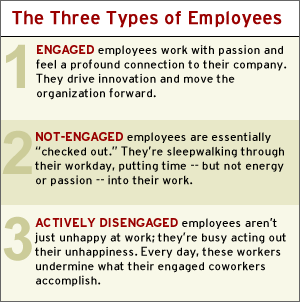
Employees Engagement and Feel Good Factor


Wo! I feel good, I knew that I wouldn't of I feel good, I knew that I wouldn't of So good, so good, I got you Wo! I feel nice, like sugar and spice I feel nice, like sugar and spice So nice, so nice, I got you

These lines of James Brown famous song could be the dream goal for each HR professional. HR team can only dream that its employee sing these lines every morning when they come to office. Employees feel good factor and happiness level has been a key area of research work for Economists, Psychologists and Management thinkers.

Gallup Management Journal surveyed U.S. employees to probe their perceptions of how happiness and well-being affect their job performance. Gallup researchers examined employee responses to see which factors differed most strongly among engaged employees (27% of respondents) and those who were not engaged (59%) or actively disengaged (14%).

When American employees were asked how often they feel challenged at work, a majority of engaged workers (61%) said they feel challenged very often, while 35% said they sometimes feel challenged. In contrast, just 49% of not-engaged and 24% of actively disengaged workers indicated that they very often feel challenged at work; 39% of not-engaged workers and 42% of actively disengaged workers sometimes feel challenged.

Respondents were also asked how often they feel frustrated at work. Here, the differences were even more striking. Almost 4 in 10 engaged employees (39%) indicated that they rarely or never feel frustrated at work, while only 13% very often feel frustrated. In contrast, 6 in 10 actively disengaged workers and 26% of not-engaged employees said they very often feel frustrated.
These responses suggest that while engaged workers do feel challenged at work, they view these challenges in a much more positive light than do less engaged workers.

When asked how difficult it would be for their employer to replace them, 54% of disengaged employees said it would be extremely or somewhat difficult for their employer to replace them, compared to 76% of engaged employees. Engaged workers also felt significantly more secure at their workplaces: 54% of engaged workers felt more secure at work than they did a year ago, but only 36% of not-engaged workers and just 18% of actively disengaged workers agreed that they felt more secure at work than they did a year ago.

To read more click here

Thursday, December 22, 2005

How to have Fun @ Work

Employee’s motivation and engagement is the key mantra for attracting, developing and retaining Human Talent. Organizations are striving to make work exciting as well fun activity so that they get greater employee involvement and commitment. Employee’s perception about work is believed to be the driving factor. To build this reputation and promote a fun culture here’ some essential guidelines for HR Folks.

Allow for flextime. Giving your employees some flexibility in their work schedules shows your concern for their personal lives. In addition, allowing employees to work from home occasionally can be a great motivator, making the days in the office a lot more productive and less stressful.

Schedule exercise breaks. There’s no reason you can’t copy what many larger corporations are doing these days -- squeezing in stretch/dance breaks throughout the day during which employees step out of their offices or cubicles to do a group stretch to music.

Cultivate fun.
Make your office an exciting place to be by holding frequent contests, celebrations, and team-building activities. Surprise everyone by ordering in lunch or by starting out the day with coffee and pastries in the kitchen. Be creative.

Lead with laughter. Understand that taking 15 minutes to laugh will increase productivity, not reduce it.

Encourage mini time-outs. Encourage everyone to relieve daily stress by taking a few minutes to do something they enjoy. A small break in the day’s routine can really reinvigorate a person’s thought process. Take short breaks yourself and encourage others to take them.


Find the humor in negative situations. Lead the way in joking about difficult situations in the company. When people can laugh in the midst of a impending deadline, make fun of themselves after making a mistake, or share the story of a horrendous (but humorous) customer experience, they can defuse a lot of tension and stress.

Create a fun squad. Ask for employees' ideas for ways to add fun to the workplace. Consider creating a “fun squad” whose job is to dream up ways to bring lighthearted fun into the office.


Build a “Wall of Fame.” Designate an area where you can post pictures of team members, thank-you notes from clients and customers, and clippings about the organization’s success.

Designate a humor corner. Transform one corner of your break room or other area into a humor corner. There you can post cartoons, funny quotes and pictures, and other illustrations designed to relieve stress.

To read more click here

Tuesday, December 20, 2005

Effective E:learning Approach

E learning is going to be of the most preferred and commonly adopted mean for higher education. Its going to be all the more relevant for management education since it’s a wonderful mean for acquiring and developing new knowledge skill and competencies for high level of performance. However the learning ability and style of individuals has been well researched for the traditional method but the e learning mode of education has its own peculiar results.

In an article titled Learning Styles and Study Habits Ryan Watkins discusses about the challenges of e learning. He suggests ways to make the learning session more effective based on individual learning style suited for online method.


Learning Style Is Visual
As a learner who prefers visual elements in his or her instruction, what study skills do you believe are most useful in the online course environment? For example, drawing pictures or mind maps as you read online materials, paying special attention to the images or animated graphics, and/or envisioning the topic in your thoughts.


Learning Is Auditory
As a learner who prefers auditory elements in his or her instruction, what study skills do you believe are most useful in the online course environment? For example, developing an internal conversation between you and the text, reading aloud, and/or discussing the topic in verbal conversation with a peer, family member, or colleague at work.


Learning Is Tactile/Kinesthetic
As a learner who prefers tactile/kinesthetic elements in his or her instruction, what study skills do you believe are most useful in the online course environment? For example, taking careful notes while reading online material, using a pencil or highlighter to mark your notes, using an online highlighter (fir example, with PDF files or Microsoft Word documents), and/or keeping an online journal.

Monday, December 19, 2005

Best Ethical Practices Awards

Recently the 17th business ethics awards were announced by the Business Ethics Magazine and the winners list has the following names;

Intel:For leadership and excellence in corporate social responsibility management.
A computer chipmaker in Santa Clara, Calif., Intel has 90,000employees. It posted double-digit gains in 2004 for revenue of $34.2 billion. Net income for 2004 was $7.5 billion, up 33 percent from 2003. Long a darling of the social investing community, Intel is included in 50 different socially responsible mutual funds. Last year, it ranked No 5 in Business Ethics' 100 Best Corporate Citizens list. And it made the Dow Jones Sustainability Index for the seventh year in a row. It was the sixth company in the U.S. to report in accordance with the Global Reporting Initiative, a rigorous international framework for corporate social reporting.

South Mountain Company:For using employee ownership as the foundation of a
life-enhancing company.

WHEN THE EMPLOYEES ARE THE OWNERS, and they are charting the course, essential business priorities change,” says John Abrams, founder of South Mountain Co. "Improving the community where we live and raising our families become part of our basic priorities.All of this is made possible by the firm's ownership structure.

After Abrams split with his two founding partners in 1985, he transferred ownership to a worker-owned cooperative corporation (in which he shares ownership). Today, there are 16 employee owners and another 14 working toward ownership. After five years employees can buy into ownership. Since the company has no outside investors and no non- employee board members, Abrams writes, "We decide what kind of business ours will be.”

That means, among other things, that South Mountain pursues a policy of conscious
growth rather than maximum growth.

New Leaf Paper: Environmental Excellence Award: For mainstreaming ecological
principles into the paper industry.

San Francisco-based New Leaf Paper Co. has since 1998 been in the business of saving trees -- nearly 700,000 to date, since over half the fiber used in its papers comes from post-consumer waste, rather than virgin pulp from trees. That's not to mention the 34 million pounds of solid waste no longer in the waste stream, thanks to the company's sustainable line of paper products, considered the most environmentally responsible on the market today.

In its first full year of operation in 1999, New Leaf Paper generated $4 million in sales. In 2005, it expects revenues to exceed $18 million. Yet with only 18 employees, this small firm is having a significant impact on its industry. "The mission of our company is to inspire the paper industry to move toward sustainability. We essentially married our own success with our environmental goals,” said founder and CEO Jeff Mendelsohn.

Weaver Street Cooperative, Living Economy Award: For its sustainable products, community focus, and democratic governance.

Weaver Street is more than a food market. It runs a restaurant, Panzanella, also devoted to locally produced and seasonal foods, which hosts frequent special dinners and wine tasting to show off local producers. The cooperative donated staff time and unused real estate to create a new community radio station. And it created a nonprofit to build affordable housing. When residents nearby wanted a second market, they approached Weaver street to open one. It did so, and 600 subscribers signed up to finance the venture.

To read more click here


Friday, December 16, 2005

Designing an Effective Learning Program


On of the biggest question which any learning Manager faces today is designing and customizing a training program. Often one wonders about the likely efficacy of a program for a particular role and position.

Glen Spielbauer has given some useful tips for learning officer in designing any learning activity. He feels that as the chief learning officer, you must be the driving force to push your company’s productivity to higher levels. To truly empower your organization, be proactive, not reactive

Include all your employees, not just the managers or professionals: Do not neglect the rank-and-file employees who truly determine your bottom-line success. Individual contributors are the ones who build customer relationships and put quality into your product or service.

Don’t reinvent the wheel: Make sure your training adds to the knowledge that employees already have from their college training. (This includes both two-year and four-year graduates.)
Utilize those with two-year and four-year degrees: It is essential ensure that all managers understand the advanced level of graduates of two-year community colleges and technical institutes. Graduates of two-year associate degree programs have expertise that often overlaps with four-year graduates and should be treated as professionals in their own right.

Incorporate local community colleges: Use local community colleges as an integral part of your corporate training strategy. Many community colleges provide regular and custom-designed short courses for corporate clients, sometimes even on-site. These include customer service, e-commerce, quality assurance, project management, technical writing, telecommunications and computer network technology.

Your overall agenda must be coherent and unified, not piecemeal: Include all departments and all levels and types of employees. Although specific training may be targeted for certain functions (such as marketing or manufacturing), all training objectives must be a part of a “top-down” design to be truly effective.