Seth Godin is interviewed by Tom peters in the cool interviews series.What my blog does for me is it keeps me from writing a book every month, or a long PowerPoint presentation. What the blog does is let me take an idea that's nascent, and share it, and see what happens to it, as opposed to having to invest months or years into fully polishing it.
I'm the first to admit that half the ideas on the blog are nonsense. I just don't know which half. This is a neat way for the community to think about things a little differently. So it's a really good sort of steam valve for me.
Monday, August 21, 2006
Why do you Blog??
Saturday, August 19, 2006
Talent Management Strategy:II
How do you ensure that managers, employees, HR and senior management are equally benefited from your Talent management strategy?
Some of things which HR can work out while coming up with a talent management strategy is to identify the areas of common interest and conflicts. Based on this it can work promoting and communication the areas of common interest and work of ways to ensure a solution to possible or existing areas of conflict.
Often we end up covering the areas of conflict or disagreement which is not a good strategy in a long run. One of the typical mistakes which happen at the time of recruiting is over –promise and compromise on relevant relieving documents to be submitted at time of joining. Some times the business needs are to pressing to lead to such situations but such steps leads to future conflict areas and dissatisfied employees.
Thursday, August 17, 2006
Talent Management Strategy
● Given its importance, the strategy needs to be driven from the top. CEOs and COOs should oversee talent management strategy rather than delegating it to HR departments. HR, in turn, should be made responsible for supporting the strategy and executing it.
● Talent management should be explicitly linked with overall strategic planning and deliver the quantity and quality of leaders the company will need in the future to achieve its goals.
● Formal processes for identifying top talent, including performance evaluations, and strategic reviews of key talent should occur at least annually and incorporate written feedback to buttress scored categories. There are many other components required in a good programme, and a rigorous approach to obtaining reliable performance data is essential.
● Smart companies communicate effectively about the importance of talent management. By publicly recognising and rewarding deserving candidates with promotions and other awards, companies can cultivate an environment in which talent flourishes.
● A varied business background is the best grounding for the CEO and COO roles. As today’s corporate leaders face such diverse challenges and opportunities, firms are looking for people with wide experience in terms of function, role, and, increasingly, geography.
● Talent development programmes should combine both theory and practice in the form of structured learning experiences and off-site meetings, as well as the proper business experience. They should be supported on a daily basis by coaching and mentoringOne of the typical problems which HR faces in some organizations is the lack of support and buying from Senior Management and Line managers in Performance Management programs. As the report suggests that CEO's need to take the ownership of talent management strategy and drive the same with HR as its partner. Despite HR coming up with structured, measurable matrix to capture performance data and review processes the actual execution of the process lies with line manager. Line’s manager inability to share and appreciate the process leads to failure of most of such initiatives.
Some of the steps which can be taken to avoid this situation :
Senior and line managers must be trained regularly on the talent management philosophy by the CEO and HR folks at regular intervals.
Involve and create Process champions for Talent management from Line managers.
Communicate the efficacy and results of such programs and all levels.
Educate about the talent management philosophy right from the time of induction and ensure that each employee understands his personal role in managing his career and performance.
Wednesday, August 16, 2006
Recruitment and HR function
Should recruiting be part of the HR department?
Yes, it should be part of HR: 37% :94 votes
No, a separate department :45% :114 votes
Depends on the company :18% :46 votes
None of the above : 1% :2 votes
Total: 256 votes
Recruitment lays the foundation of HR functions and for generalists as well as specialists HR folks the recruiter’s role is always a challenge. From Line managers and Boards members’ perspective Recruitment has greater visibility in terms of meeting organization manpower need and the business objective.
Monday, August 14, 2006
Talent Poaching
“Wipro Biomed, the life sciences division of Wipro Ltd, has won an order from the Delhi High Court restraining the company's long term partner Beckman Coulter from luring its employees, albeit temporarily. Beckman Coulter is understood to be preparing ground to enter India on its own. The ruling has put the spotlight back on the poaching phenomenon that is threatening to snowball into a major controversy affecting the Indian industry across sectors like life sciences, aviation and BPO.Talent Poaching or Talent acquisition? How do you define it? Most of the developed nations have already witnessed this trend and have come up with confidentiality clauses to prevent people from joining competitors.
Does poaching actually help organizations fill roles? Here's one viewpoint.
The war for talent has intensified and organizations are using every rule in the book to retain the competitive advantage of skilled workforce. However do you feel that it’s fair to have clauses in terms of agreement in order to restrain employees from making career moves?
After all when the high demand for a particular talent/skill may remains only for a specific period of time, so why not let them make hay when Sun shines.
I’m sure HR folks will disagree. But in a perfectly competitive market labor is mobile and most of the organizations today believe in buying skills rather than developing skills.
Large and established organizations typically have large training facilities and spend on developing quality manpower. However some prefers to adopt the buy strategy and are willing to pay extra for folks with some experience and training. This situation presents a unique challenge to HR in all organizations.
Typically any country which grows at a fast pace but fails to develop adequate infrastructure to develop skilled manpower faces such talent crunch. Indian software talent is one such example in case. This war is likely to get worse in the days to come as global supremacy will depend on the talent pool of the country.
Friday, August 11, 2006
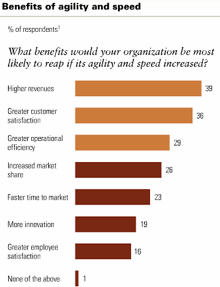
Organisational Agility and Speed
The findings, from a new McKinsey Quarterly survey, suggest that managers across all main regions and industry sectors acknowledge the increasing significance of agility and speed.
In the survey an organization's "agility" was defined as its ability to change tactics or direction quickly—that is, to anticipate, adapt to, and react decisively to events in the business environment. "Speed" was defined as a measure of how rapidly an organization executes an operational or strategic objective.
Some of the major findings are:
Almost nine in ten respondents say agility is either "extremely" or "very" important to business performance, and 86 percent say the same about speed.
The two organizational elements that most contribute to agility and speed, the two top choices (identified by 41 percent and 39 percent of the sample, respectively) were a clear link between company strategy and the performance goals of individual employees and decision-making authority pushed as far down the organization as possible.
Turning to behavioral and attitudinal issues, more than half of the respondents (57 percent) think sensitivity and responsiveness to customer needs constitute the key to increasing agility and speed.
The survey also sought to explore the main organizational, behavioral, and attitudinal barriers to greater agility and speed. Half of the respondents complain about overly centralized, slow, or complex decision-making and approval processes. And around one in four highlight poor coordination and control of multiple initiatives; inconsistent communication of objectives and targets; boundaries, real or imagined, that impede the flow of information and ideas; and unclear accountability.
As for "softer" barriers, one in three respondents cites a lack of employee purpose, commitment, and motivation.
Thursday, August 10, 2006
Leadership Development
I was coaching a CEO just recently who was brilliant and really good at strategic thinking and planning but had a huge underdeveloped capacity around growing people and the whole area of leadership development. It was a huge risk, not only for him, but for his firm as well. And this is a most common issue that we see around partial leadership in large and small companies today, the over focus on head.
We also see that there are some people who really are good at inspiring, and motivating, connecting with people through loyalty and commitment. We call these heart leaders and they really are good in the short term at inspiring people to perform, but sometimes over the long term can’t make the tough choices that are needed for success or they can't give tough feedback or make hard decisions around letting people go.
And then finally we have seen some very intuitive and instinctive guts leaders we call them, who can make bold moves, who can act with little data. They may really attract attention in the short term, take big risks, but in the long term they may get caught up in the drama of their bold moves.
Organizations typically focus on developing leaders at Senior or Top management level but rarely focus on developing leadership skills at middle and junior level. A close look at any organizational functioning will reveal that leadership at the middle management level is the critical factor for organizations success.
Employee’s perception of organizations functioning is seldom driven by the leadership at senior level, it the middle management level which does the balancing act of managing teams and project execution. Attrition, team engagement and productivity is directly connected to Managers ability to manage teams. I’m sure greater efforts on managing talent and developing leaders at middle management level does more than any other retention Strategy of the organization.
Tuesday, August 08, 2006
In this age of Free Lunch
However the new generation of twenty-something lives in what Chris Anderson terms "the Long Tail," a term he coined in his Wired magazine column and that is the title of his new book. The "Long Tail" describes the region of the item "popularity curve" comprising the vast population of least-popular items, whether it is song titles, books, or little-known brands.
Has technology given the new generation a new gateway to access free, unlimited information? What happened to the Marshall’s good old Demand Supply Partial Equilibrium theory?
In Anderson's view, all of these drive demand down into the tail, which he terms "a culture unfiltered by economic scarcity." In the Long Tail, money is made by such things as avoiding inventory, producing to order, letting customers do the work, pricing creatively and flexibly to various customers, utilizing a variety of distribution methods, sharing information, trusting the market to do your job, and understanding the "power of free" combined with money-making services or products.
HR Paradigm
Organization strategy is not just driven by the technology they possess and the health of the balance sheet, the critical differentiator is the ability of the firm to scale up to the new growth trends. Growing market uncertainties has varied impact on the organizations future growth potential. Does this translate into an opportunity for the HR, to make its path breaking contribution in defining the Business Strategy of the firm?
Let’s imagine another situation in which marker trends are predictable and technological trends are going to remain stable over a period of time. In this situation do you see HR being considered as critical partner in firm strategy execution?
Chances are that HR will be delegated to do the regular predictable maintenance function and its true worth of leading from the front may remain a distant dream.
So does it means that this is best time for HR make its move from an enabler function to strategic decision maker in deciding the firm’s execution strategy.
Are we prepared to rise to the challenge?
A 2002 survey by the Society for Human Resource Management found that a dismal 34% of executives felt that HR was viewed as strategic business partner. However a careful examination of current trends which drive business decision making shows that HR is the only leading function which can play the most strategic role.
Top 3 drivers in today’s business environment are:
s Speed
s Technology
s Culture and Innovation
Speed: Business decision making is a factor of dynamic environment and speedy decision is key for effective results. Since the environmental variable continues to be ever changing the speed in execution is a function the healthy process and quality practices existing in the organization. Speed in decision making and execution is also characterized by the structure of the teams and units inside the organization. Organizations which have a flatter, nimble and decentralized decision making system in place are in a position to deliver solutions with speed.
Technology: After speed one of the greatest enabler in today’s business environment continues to be technology. Human Resource Functions has leveraged immensely by the effective use of technological tools. It has enabled the HR function to deliver consistent, effective and reliable solutions. Technology assists HR strategy and Business strategy in scaling up to great levels and organizations toady can’t conceive achieving its long term goals with out putting a healthy HR Technology in place.
Organizational Culture and Innovation: Innovations drives the future growth potential of organization and HR plays the most critical enabler in setting the context for a culture of Innovation.
Studies show that with competition getting intense, HR is a primary driving force behind organizational change and technical innovation. Innovations in organizations are function of the culture.
Deal and Kennedy (1982) argue that culture is the single most important factor accounting for success or failure in organizations. They identified four key dimensions of culture:
1. Values – the beliefs that lie at the heart of the corporate culture.
2. Heroes – the people who embody values.
3. Rites and rituals – routines of interaction that have strong symbolic qualities.
4. The culture network – the informal communication system or hidden hierarchy of power in the organization.
Human Resource functions and philosophy of an organization lay the foundation of the healthy and supportive culture. Innovation and organizational culture is the biggest differentiating factor when it comes to be flexibility of approach and responsive to the changing environment.
With this context one can assume that Human Resource functions is the most critical function which will play the most important role in ensuring that organizational not only stay ahead in the war for Talent but also play the strategic role in achieving the business objectives.
Monday, August 07, 2006
Capitalism and Social Change
Fast Company article talks about the Social Capitalist winners who have developed some best practices that leaders in any sector can learn from.
Thank your customers. Then thank them again.John Wood, CEO and Founder, Room to Read
We make it a policy to almost "over-thank" our donors with as many creative gestures of appreciation we can imagine. In addition to establishing libraries and building schools, we publish native language books.
Let your customers sell for youPaul Rice, CEO and Founder, TransFair
Our model is to mobilize consumer demand for products that pay farmers a fair price so companies that distribute our certified products are rewarded for doing the right thing. That means that our customers are our most powerful advocates. So we need to find ways to support them and encourage them to speak up, without fostering an aggressive, anti-corporate stance with the companies we want to carry our product.
Recruit the right customers, in the right networks.John Wood, CEO and Founder, Room to Read
We think of these folks as our buzz agents: they talk us up in circles of influence where people are interested in international development and have money to spend.
Do your market research in the field.Christopher Elias, PATHOne of the health technologies we're exploring for use in the developing world is a high-pressure jet injection device that administers shots without a needle. Basically, it puts a stream of fluid under such high pressure that it pierces the skin. Not having a needle eliminates the chance of cross-infection.
Understand the emotional appeal of your brand,Paul Rice, CEO and Founder, TransFair.
People are looking for a way to make a difference. They're concerned about the direction the world is going in. There's so much bad news everywhere. Many people feel like their voice isn't being heard, their vote doesn't count. So maybe fair trade is giving people a way to find that voice again and to feel like they actually can make a difference.