Sunday, December 17, 2006

Employee productivity and Induction

According to a new survey from Salveson Stetson Group, almost two-thirds of companies admit that they don't do a good job of integrating newly recruited managers and executives into their new roles.

The survey of some 100 companies found that only one in 10 felt they did an excellent job of integrating new senior hires and a further quarter felt that their efforts were "good". Of the remainder, almost half (46 pert cent) said that their efforts were average and 17 per cent admitted that they were poor.

"Once the hiring process is complete, many companies fail to provide sufficient assistance to integrate newly recruited executives into their organizations, which can lead to poor performance and an early voluntary or involuntary exit," said John Salveson, Salveson Stetson Group co-founder. In particular, many companies fail to adequately assimilate new hires into their organisational culture; something that co-founder Sally Stetson said is one of the major reasons why newly-recruited employees fail.

Formal Induction process with ensures that the organization values, culture and structure in communicated well to new employees is critical if one has to engage employees from day one.

Research by Jamie Gruman, a professor in the School of Hospitality and Tourism Management at the University of Guelph in Canada, suggests that employers who make the socialization of new recruits a priority and develop programmes to integrate them with differing levels of experience and responsibility can expect greater retention, productivity, commitment and initiative.

"The bottom line is the more structure there is around the socialization of new employees – informing them about the kind of training they'll receive and when training will take place — the more likely new employees are to seek information and feedback and view themselves as part of the organisation," he said.

Thursday, December 14, 2006

BPO and Trade Unions

Kari Tapiola, Executive Director of International Labour Organisation (ILO), today said employees of Indian BPOs are well within their rights to unionise themselves and national-level unions can also reach out to them.

"All employees, whether in the formal or informal sector, need to have their voice and a bargaining partner," Tapiola said when asked whether the growing number of BPO employees should organise themselves into trade unions. He said while the national-level unions could reach out and encourage the BPO workforce to organise themselves, the decision to align with a particular union should be left to the employees themselves.

True, we must ensure that workers right and privileges are protected and the safeguarded by the law of the land. But do we need Trade Unions to take up the BPO employee’s rights and issues? Not really, trade unions may not help BPO as the nature of the industry is very different from the very concept of a trade union which is based on the notion of collective barging.

Today when BPO’s are struggling hard to retain employees and work place resembles more like an airport where people keep hopping in and out every minute, trade Unions are not the solution to employee’s problem. Given the background of recent concern on security breaches by Indian BPO’s and growing alarm over the integrity issues ,if Trade unions were to become a reality it will certainly impact the growth and reputation of Indian BPO industry.

Monday, December 11, 2006

Sapphire weekly News from HR world


SAPPHIRE Weekly
News from the HR World
School of Business & Human Resources


Editor’s Recommendations

Sapient achieves 'Best Place to Work' recognition in all countries of operation
Burning Within-The Influence of Organizational Respect on Burnout
Attracting Top Talent Via Employment Branding Tactics
TCS unveils 'science-to-software' transformation program
Can the Internet Be Your HR Department?

NEWS

Work Force Management

Sapient achieves 'Best Place to Work' recognition in all countries of operation

Sapient has been named number 5 in the "Ten Best Companies to Work for in India in 2006" ranking by Business Today magazine, Mercer Human Resources Consulting and TNS India. This recognition, which marks Sapient's third consecutive year as a best place to work in India, builds on the company's numerous workplace awards in Canada, Germany, India, the United Kingdom and the United States of America.

Multiple institutions around the world have recognized Sapient for its distinctive culture and use of career management mentorship programs to accelerate development and growth. The company has been ranked recently in such workplace lists as Canadian Business' "Best Workplaces in Canada," Capital magazine's "Germany's Best Employers," Businessworld and Great Place to Work Institute's "Top 25 Great Places to Work in India," and Consulting magazine's "Top 10 Best Consulting Firms to Work For."

To find out more click on the title


Burning Within-The Influence of Organizational Respect on Burnout

One of the biggest complaints employees have is they are not sufficiently recognised by their organizations for the work that they do. Respect is a component of recognition. When employees don't feel that the organization respects and values them, they tend to experience higher levels of burnout.

Disrespect is experienced across industries; disrespect for individuals may be particularly problematic in the helping professions where concern for individuals is paramount.

A company's culture plays an important role in burnout. The more they feel respected as a member of the group, the more likely they are to have a sense of identification.


To find out more click on the title

IBM Settles to Pay $65 Million In Overtime to IT Workers

Technology giant IBM agreed to pay $65 million to settle allegations that it failed to pay overtime to technical services and information technology employees, according to a preliminary settlement filed Nov. 22 in the U.S. District Court for the Northern District of California.

According to the complaint filed in the case, the employees alleged that their primary duty was to install, maintain, and support computer software and hardware for IBM and its customers, but that they were misclassified as exempt employees and ineligible for overtime.

To find out more click on the title

Recruitment
Measuring The Success Of Hiring Managers

Who were those managers who picked the applicants who went on to succeed? How did they make their hiring decisions? Could the criteria they applied be adopted by other hiring managers throughout the company? These are good questions that most HR professionals don't ask. Because of that, experts say, they are missing out on a golden opportunity to tap and duplicate a valuable resource in their organizations, best practices of successful hiring managers.

Until recently, HR's metrics in recruitment and talent selection have been concentrated on efficiency, measuring cost-per-hire and time-to-fill data. Now, experts maintain that efficiency is only part of a winning formula; quality must be the other part.


To find out more click on the title


Attracting Top Talent Via Employment Branding Tactics

While assessment enables you to make such distinctions among candidates once they have applied, it is your employment brand that ensures you have the right quality candidates to evaluate, in the first place. In other words, assessment is useful only if your organization can:

1. Attract the top talent who will fit in and
2. Persuade them to apply

How does an employment brand accomplish those tasks? It must address the issues that matter most to the people you most want to hire. It must focus on the key motivators for the unique cohort of the workforce that is right for your organization.


To find out more click on the title.

Performance Management

Taking Some of the Dread Out of Performance Reviews

New software promises to make the annual performance review easier and faster, while assuring top executives that employees are being rated consistently on skills and objectives that are in line with overall corporate goals. The tools, usually part of a suite of performance-related applications, can coach bosses through the appraisal process, help them calculate scores and offer tips for writing reviews. At the same time, they provide reports on who has and who hasn't completed their reviews, along with a full picture of the capabilities, experience and accomplishments of the entire work force.


Training and Development


TCS unveils 'science-to-software' transformation program

Tata Consultancy Services (TCS) has unveiled its latest initiative to enlarge and develop the suitable talent pool available to the IT industry.

The TCS Talent Transformation (TCS T2) aims to transform science graduates into global software professionals and is the first scalable program undertaken to draw graduates from disciplines other than engineering into the global technology services industry. With lack of suitable, trained talent identified as a key potential barrier to growth, the TCS science-to-software program is designed to be a hi-tech, hi-touch learning module that aims to transform B.Sc./BCA degree holders into best-in-class IT professionals.

The TCS Talent Transformation program is designed to spread the economic benefits of employment in the IT industry to wider base of science graduates across India. This will be done through a fast, scaleable model that has been designed to reach out to the large mass of science graduates in the country, irrespective of locations.

Designed as an intensive 7-month residential transformation program, the curriculum will include formal lectures, projects and assignments, quizzes and interactive sessions. The selected graduates will undergo courses in the principles of software development and IT, develop an understanding of core technologies underlying IT systems as well services like package implementation as well as new technologies like Java, .Net as well as TCS' proprietary tools, frameworks and quality processes.

To find out more click on the title

The State of Training and Development: More Spending, More Scrutiny

As investment in training continues to rise, with resources migrating away from in-house programs, employers are demanding better accounting to ensure that their development dollars go toward furthering strategic goals and bolstering the bottom line.

Technology and global competition, the two driving forces of economic change in today’s business world, haven’t bypassed the once-staid world of training and development. Companies seeking to gain advantage through better-trained and better-developed workers are employing everything from e-learning delivery systems to multicultural and polyglot training solutions. They are hiring chief learning officers to deal with the increasingly complex field. And they are demanding better accounting of results.

Yet despite the focus on efficiency and cost control, overall spending on training and development continues to rise, a reflection of the fact that companies are ratcheting up the amount of training they require of their workers in the ceaseless drive for a competitive edge. Companies clearly subscribe to the belief that smarter, better-trained workers increase chances for success.

To find out more click on the title.


Compensation

Thousands of BPO jobs that pay BIG


Business process outsourcing lives. Initially, it was driven by foreign companies that shifted work to India to save on labour costs. But with time, it has thrived and evolved. Now, a number of Indian companies too are farming out work to specialist outfits to keep expenses down. These outfits comprise the 'domestic BPO' sector. In terms of employment, it is still a relatively small part of the BPO pie, but it is booming.

According to National Association of Software and Service Companies, during 2002-05, the domestic BPO sector saw employment grow at a compounded rate of 60 per cent, to touch 352,000.
But, it expects employment to rise only marginally in 2006, to 365,000. IT research and consultancy company Gartner, however, expects employment in the sector to grow at about 50 per cent annually.

Some of the bigger players in this market are IBM-Daksh, MphasiS, TeleTech and Hinduja TMT. While they have a sizable chunk of foreign business, their domestic business is substantial too. Third-party players like Orion Dialog, Sparsh, Magus, Infovision, Solutions, Customer First and Mobilink have a sharper focus on the domestic business.


To find out more click on the title


Technology

Can the Internet Be Your HR Department?

Typically, the single largest expense for a company of any size is the cost of payroll and managing personnel issues. As companies grow, headcounts increase and so does the process of maintaining payroll, benefits administration and other corporate policies, such as vacation schedules, sick time, hiring, etc. The good news for small- and medium-sized businesses (SMBs) is that they no longer need a dedicated department to manage human resources (HR) activities.
The Internet is playing a pivotal role in this change.

By leveraging Web-based HR technology platforms, SMBs can now offer “big business” services to employees while enjoying the time and cost efficiencies associated with a centralized system.
While these methods and systems have their merits, the Internet has enabled SMBs to realize greater efficiencies by utilizing hosted HR platforms. These systems eliminate the need to purchase and maintain applications and servers, are extremely easy to use, and are accessible via standard Web browsers and an Internet connection. They are also secure and very affordable with pricing models typically scoped on a per employee basis.

To find out more click on the title.


Letters to the Editor
Regards,
Aditya VS
Jhumur Thakur
Team SAPPHIRE
PS: Pls send in your feedback at sapphire@xlri.ac.in

Tuesday, December 05, 2006

Is it just Profit Motive ?

Wasserman talks about what motivates entrepreneurs? Is it Money? Or Control? Or is it that some entrepreneurs are expecting to get rich. Others want to grow and control a new venture. But most would probably answer: "both."In his paper called "Rich versus King: The Entrepreneur's Dilemma," suggests ways that entrepreneurs can work toward being both rich and royal.

Profit motive was competing with other motivations, most prominently the control motive. Most of the founders I have studied started off wanting to become both Rich and King—"Rich and Regal," if you will. This desire is reinforced when they see such prominent Rich and Regal entrepreneurs as Larry Ellison of Oracle Corporation, Marc Benioff of SalesForce.com, and Phil Knight of Nike. What's ignored is that these people are so well known precisely because they are the exceptions, the rare founders who are able to achieve both. Many others I've studied who tried to achieve both have ended up making some decisions consistent with Rich motivations and others consistent with King motivations, and in the process of mixing the two, ended up with neither.

Interesting observations ,but I guess money remains a motivator till an organization grows to a critical size and then it’s the organization growth and competitive ability of the firm which becomes the critical motivator for the entrepreneurs.

Thursday, November 30, 2006

Impact of Employee Referral's Program

In an interesting analysis Gerry Crispin talks about the impact of employee referral on firm’s hiring over the Job boards. Not that job boards are ineffective but employee referrals are far more effective and have a greater impact than Job boards.

He gives these inputs to substantiate the idea;

Analyzing actual data (as opposed to guesses) from 24 specific firms who filled 188,000 positions during 2005 showed that 32% of the 188,000 were filled with internal movement and promotion. Of the remainder, the folks who were hired externally, 27.1% were filled by Employee Referrals. (source: CXR Annual Source of Hire Survey)

In a second study of employee referrals,More than 50 firms reported that the ratio of the number of hires to the total number of referrals during 2005 produced a yield ranging from 1 hire for every 10 employee referrals to 1 hire for every 2 employee referrals (with 1 hire for every 4 or .25 being the average). (source: CXR Colloquium Benchmark on Referral Practices)

If all companies hired the same percentage of employee referrals (they do not) and, if the average yield for referrals were true for all companies large and small (they are not) then a typical job seeker (there are none) has .271 X .25 chance of being hired if they get a employee to refer them - or about a 6.5% chance of getting hired if they simply focus on getting an employee in a targeted company to refer them.
Previous post on employee referral here .

Tuesday, November 28, 2006

Employee Engagement and Leadership

Business needs are not just driven by your external customers and need but also subject to your internal customers. Employees are the key to internal customer’s satisfaction level and different aspects of engagement are put in place in organizations to achieve high internal customer satisfaction. Leaders play the most pivotal role in communicating and giving the message of being an internal customers to Employees.

Ram Charan outlines five steps to engage employees and talks about how attitudes, feelings and emotions that makes work enjoyable and ignites people's energy to do more than they thought they could. Great leaders understand the numbers, but they also touch people's hearts.

1. Spend time and listen.There's no substitute for personal interaction. Even the most competent, motivated professionals can lose focus, energy, and commitment when their interaction with the boss dwindles. Some people will assume others have your ear and feel less important. Others will simply feel overlooked and underappreciated.

2. Help people see why their work is important.It's hard to feel engaged when you're working in a vacuum. You can help people see their individual contribution as part of a bigger picture.

3. Give people honest feedback.
When people aren't meeting expectations, let them know that, too, so that they have a chance to improve. Don't let your disappointments build and fester. If you talk to people regularly there'll be no surprises.

4. Take an interest in people's careers.People will be all the more committed to their work when they know you're the kind of leader who is truly interested in their success. Look for what people are naturally good at and work with them to find ways that they can leverage their talents. This applies to your underperformers as well as your superstars.

5. Take an interest in the person beyond the job.Not every conversation should be about work. People have lives outside of work; indeed, some people are very different outside of their jobs. People will know you care about them if you take time to learn what's important in their lives.

The Full Measure of Leadership

It's in your daily behavior, and it's your energy that creates energy in others. It's that simple.

Put your beliefs into action. Treat people like human beings with full lives, personal ambitions, and both the desire and the right to be valued and heard. Is it different from what you see around you? Maybe so, but that's what leadership is all about.

Monday, November 20, 2006

Asian Heroes

Time magazine has come out with a special issue on Asian heroes. Heroes from five diverse fields which include Arts, sports and Business have been identified. It’s interesting to read the success story of heroes of our times.


Photobucket - Video and Image Hosting


Some interesting leaders like Meena from Afghanistan are really inspiring.

In 1977, at the age of 20, she launched the country's first movement for women's rights, calling her group the Revolutionary Association for the Women of Afghanistan (RAWA). Its goals: the restoration of democracy, equality for men and women, social justice, and the separation of religion from the affairs of the state.

Nobel laureate Mohammad Yunus from Gramin bank on how he started his journey.

In 1974, famine gripped Bangladesh. Hundreds of thousands died and millions became destitute. For Yunus, who had just returned to Bangladesh as an economics professor after completing his Ph.D. in the U.S., it was wrenching to discover how meaningless his academic achievements were in the midst of all this suffering. Hoping to cure his own sense of helplessness, he wandered the muddy lanes of a village next to his university, searching for ways to help. Little did he know that this nervous exploration would plant the seeds of an economic miracle still blooming decades later.


On how Yahoo became a success story.

Created by two Stanford students, Dave Filo and an expat Taiwanese named Jerry Yang, the site was a directory of other websites, organized as a list of useful topics. It was meant for the students' friends, but everyone was hungry at that time for a guide that helped make sense of this chaotic new medium, so Yahoo! quickly became essential for all Web users.

Saturday, November 18, 2006

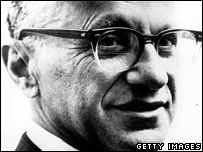
Milton Friedman :1912-2006

Renowned economist and social scientist Milton Friedman died this week on Friday .A supporter of free market economics and the father of monetarism who popularized the term "there's no such thing as a free lunch", he was awarded the Nobel prize for economics in 1976 and his thinking greatly influenced former US president Ronald Reagan and ex-British prime minister Margaret Thatcher.

The Independent reports “Over half a century, Mr Friedman, the son of Hungarian Jewish immigrants, established himself as arguably the most influential economic thinker of his time. Over that post-war period, "Friedmanism" - the belief that changes in money supply dictate fluctuations in the economy - supplanted Keynesianism as the dominant economic philosophy of the industrial world.

Friedman believed in the power of free markets, to the point where it sometimes seemed his only use for government was to regulate the flow of money. The consequence of Friedman's policies was to deepen social and economic inequality. Corporate CEOs could feel entitled to enormous pay packages if, in their view, the marketplace rather than a compliant board of directors, was responsible. Government was hard put to intervene on the side of those not so advantaged, because politicians who espoused the Friedman philosophy kept taxes low and skewed tax cuts in favor of the wealthy.

You can read his autobiography here on Nobel Prize org.

Dave Ulrich on Effective HR

Dave Ulrich on -What differentiates “effective HR” from “ineffective HR”?

HR departments, practices and professionals must add value. This means, simply, that someone receives from these HR investments something that is important to them. Often, we measure HR by what we do — staffing, training, paying, communicating — but we should be focusing on what HR delivers.

To deliver this value, HR departments often are being split in half. Some of the traditional transaction work of HR, which deals with things like payroll, hiring processes and registration for training, are done more efficiently through technology and occasionally outsourcing. More strategic HR practices, such as building collaboration, learning and leadership into an organization, require that HR professionals fully participate with the business leaders at creating more capable organizations.

So the question you need to ask yourself ,how is your work adding value to the organization and its employee in attaining the desired common goal ? I think we all face the issue of finding the right balance between the regular transactional work and collaborating on strategic business goals such as managing career aspirations and engaging employees. This a key challenge for HR in most of most of the organizations, which is being addressed to shift the focus from what we do to what we can deliver.Some have already been able to make the transition and the results are also worth analysing.Perhaps the biggest impact of this shift in focus is the change in the way HR is perceived in the organisations.

Friday, November 17, 2006

Best Companies to Work for in India

So what makes a company a great employer ?Every employer would like to study and adopt the best practices from the best employers .The sixth annual Business Today Best Companies to Work for in India recorded a phenomenal 75% increase in participation from last year and a total of 131 organizations registered for the survey.

The winners of the survey are companies who have made substantial investment in their people, infrastructure, facilities, technology and evolved HR systems. Stock options, flexi-timings, telecommuting, redressal and grievance committees, customized training and development opportunities, career management control and empowerment seem to be standard fare at these organizations. Most companies in the top ten have leveraged technology and have built truly integrated HR systems and processes. This is turn, has benefited and empowered employees who get access to information related to HR policies, performance management review, training needs and career planning tools, online.

The winning organizations have built a strong culture which reflects the values that the company wishes to inculcate in its employees. Communicating these values has gone beyond posters and employee manuals and senior management including the CEO of a winning organization personally facilitates the integrity session as part of the induction program for new employees.

So its not just the HR practices which makes the organizations great but a combination of factors like leadership, values, focus of process benchmarking and greater acceptance and responsiveness towards employees need which leads to high employee satisfaction.