Tuesday, May 16, 2006

Sucession Planning at IT Cos.

It’s a dilemma faced by most of companies when it comes to have a succession plan for top management. Some companies like GE are really good at developing and mentoring next generations of leaders while some may find it really difficult to keep pace with the changing times. ET has a repot on succession plans for IT companies.

“If you look at the dominant companies in the technology industry, most of them are still led, or until recently were led, by a charismatic founder. By and large the companies that have made the transition have done a pretty good job of it,” says Kevin Werbach, professor of legal studies and business ethics at Wharton.

While succession is important at any company, it can be even more critical at a firm run by entrepreneurs, like Gates or Jobs, who are also celebrities. “In a situation where the CEO is also the founder, it’s not just a succession event when he or she steps down,” says Wharton management professor Peter Cappelli. “These people are closely identified with the organisation and it can be extremely traumatic when somebody like that [leaves]. They have to think carefully about what kind of person could step in.”
Young start-ups flourish with creative, charismatic leaders who have a deep passion for, and understanding of, technology. But as the organisations grow, they need chief executives with a different set of skills, including the ability to delegate and to operate in a highly structured management system, says Kartik Hosanagar, Wharton professor of operations and information management. “In the technology industry, you have entrepreneurs who have been running the show for a really long time. But as these firms start to grow, they need to be looking at seasoned managers who have broad-based management skills.”

Monday, May 15, 2006

Most Admired leader


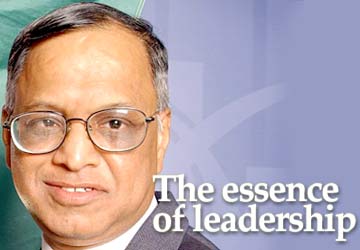
NRN as we fondly call him ( Infosys Chairman and Chief Mentor ), has emerged as India's most admired business leader, for the fifth consecutive year, in the 5th Annual B-School Study conducted by Brand-comm, a leading brand consulting, advertising and PR firm headquartered in Bangalore .

About 545 students from 13 leading management institutes across the country participated in the survey.

B-school students admire Narayana Murthy for being a socially responsible individual. He is looked up to as a leader who is honest and passionate about his work. The clarity and consistency in Murthy's personal branding and positioning seem to have been highly effective for the last five years.

It's quite fascinating to see how he has captured the imagination of the whole country. One of the most fascinating aspects of management literature has been leadership research and the concept of servant leadership truly goes with the persona of NRN.

One thing which stands out NRN from rest of the Business Leaders is ability to understand the pulse of youth. The way he communicates and empathizes with the concerns of youth today is really fascinating. He knows the kind of movies they watch the kind of music they listen. As a youth icon he really connects well. I recall a very small but significant incident which happened in Infy campus some time back when an interview session was going on candidates in the waiting room were sweating it out wondering why the A/c is not working.

Suddenly a man came from one of the entrances and looked around saw people sweating and checked the A/c switches and said "oh someone forgot to switch on the A/c ".He switched it on and walked away …. Suddenly the folks realized that it was NRN, the great man himself and he had walked away ….

This reminds of the views of Mr. Blanchard's who said that leaders need to be servants to their people.

“We don't need leaders who parade around with a big ego or try to mold their companies in their own image.."

Friday, May 12, 2006

Employee Engagement

Workplace environment is a perennial concern for HR. Employees motivation and productivity is immensely affected by enriching the working environment.Mike Goldman talks about some of the things which makes key difference .

You want to create a more fun, rewarding and productive work environment; don't try to eat the elephant in one bite. Change things a little at a time. Most organizations try to create an improved work with a plan that looks like this:

# Create a grand strategy Give the strategy a catchy name
# Initiate a change program to get everyone excited
# Implement the program with great fanfair
# Watch as early successes dissolve into boredom and failure

Instead, I believe the longest lasting changes are implemented without catchy names, colorful posters and change management teams. They're implemented quietly at first, a little at a time, until one day you look around and realize nothing is the same.

For example, a recipe for creating a more passionate, energized work environment may:
# Start with finding some small excuses to celebrate
# Use this momentum to plan a few after-work social activities
# This will help you to create stronger relationships within your team and a knowledge of what makes people tick
# This knowledge may lead to a better ability to take advantage of people's strengths
# This may lead to a change in the performance planning process as well as a restructuring of team responsibilities
Anyway, you get the idea...

To add to that I think employees are not able to relate to big bang events as much a small group /team event. Employee’s feel more connected and related to work place if they are able to bond with a small set of people.

In large organizations HR should focus more on creating a small company environment which makes the employee feel more valued.

Thursday, May 11, 2006

Role of HR

How important is the role of HR in compensation reviews?

HR is an integral part of compensation committees because it is usually the strongest link to the organization,” rather than outside consultants, for example, writes Evren Esen, lead author of the 2006 HR Practices in Executive-Level Compensation Survey Report. The report looks at compensation practices for top executives who report directly to the CEO, president or owner.

Corporations have come under increased scrutiny in recent years following high-profile scandals that have included Enron Corp., WorldCom and Tyco, which have led to a push for greater financial transparency and more stringent accountability.

Compensation for executives today is more aligned with performance, according to 42 percent of HR professionals—the only real dramatic way that organizations have changed how they operate under recent corporate governance measures such as the Sarbanes-Oxley Act, the report found.

That’s where HR has a role to play, Esen writes.

“As performance measures become more tied to compensation for executives, HR’s role will continue to be significant and HR will be called upon to integrate the different layers of executive-level compensation—legal compliance, consistency in pay philosophy, benefits and perks, and the design of performance indicators and objectives relevant to the overall success of the organization.”

Wednesday, May 10, 2006

Talent and Future Opportunities

Irvin talks about the ongoing debate on future of science and technology studies in developed countries. He wonders if the study of science and engineering will continue to lead to good, well paying careers, or whether such jobs will largely be outsourced to countries with lower labor costs, thus significantly depressing their wages in developed economies in order to remain competitive.

He gives an interesting observation on the likely changes which may see in the market requirement for technical talent in the days to come.

The marketplace requirements for technical talent are changing rapidly as technology permeates all aspects of business, society and our personal lives, and the Internet enables us to build globally integrated businesses, industries and economies.

As a result, high-wage jobs are growing in “market-facing” areas, i.e., the design of advanced systems and sophisticated applications in many industries, like government, health care, education and entertainment. These new jobs are much more collaborative, interdisciplinary and broad than in the past. They require solid technical competence, combined with industry, business and management knowledge as well as good communication and interpersonal skills.

I am also convinced that an interdisciplinary technical education will not just better prepare graduates for the market-facing positions where the vast majority of technical jobs are to be found, but will also help attract many young people to technical careers who today reject them because they perceive them to be too narrow, abstract and socially isolated.
Great observations, since the war for talent has already resulted in few major shifts in the job market for technical requirements.
Instead for Engineering background now many IT co's are already hiring BCA's,BSc's and even commerce graduates for supports projects in IT industry.
It has been observed that these recruits are highly successful on job and more keen to learn and prove there worth.
With huge demand for technical skills , ever growing competition and unreasonable expectations from employees, Co's are geared to train people on functional areas and involve them for technical projects.

Sumantra Ghosal's Book Review

HBR’s working Knowledge Review’s Late Sumantra Ghoshal thoughts on Management .

Editors Julian Birkinshaw and Gita Piramal have gathered papers that represent Ghoshal’s work over a twenty-year span. An introductory chapter by the editors traces the evolution of his career and gives context to his research and writings. The book is divided into three parts: Managing across Borders, The Individualized Corporation, and The New Management. Chapters within each section feature papers that show how his thoughts developed and why they became part of the business theory canon.

Monday, May 08, 2006

Social Tools for Networking

Social networking sites have become a useful and powerful medium of communicating and reaching out to people. Every day some or other new tools appear on the blogsphere. With more and more people are logging on to the sites , advertisements marketers can’t be expected to lag behind in this race for catching eyeballs and making ad revenue.However not all of them have been able to sustain and grow at expected rates.
On Knowledge & Wharton marketing professor David Bell says the long-term success of these sites will depend on their ability to retain the interest of their members. "There is a fad or a fashion component to all these networks. Some will come and go," says Bell. The classic example, he suggests, is Friendster, which burst onto the Internet in 2003 and soon had 20 million visitors. Late last year, it slipped below a million after MySpace and other sites with better music and video capability lured Friendster users away. "A lot of the [success] is serendipitous. These things can have exponential growth. Then, if another community shows up that has better functionality in some way, there can be a mass migration."

Wharton marketing professor Peter Fader agrees that social network sites are powerful, but mercurial, particularly since most are aimed at teenagers and young adults. "It's a complete crap shoot. Look how many of these have come along and how many were touted as the next big thing. How many have disappeared completely or find themselves in some strange little unexplainable niche?"

However some tools like Orkut, Ryze, LinkedIn and yahoo groups have really served as useful medium for connecting people and at times many of them have survived simply because they provided basic, uncomplicated service for user utility and functionally user friendly.

Sucession Planning Survey

Is your organisation having a formal succession plan for various roles in your organisation?

Take this small survey to find out

Friday, May 05, 2006

Everyone's Hiring


In sector after sector, from health care to advertising to retail to accounting, pent-up demand for workers is now boiling over, strengthening employees' hands -- and emboldening them to jump ship. Job openings, meanwhile, have increased by almost half a million positions since last summer. Nigel Gault, the U.S. economist for forecasting firm Global Insight, expects the quit rate to rise further during the next several months. "A lot of people really weren't happy where they were but had no choice, so they toughed it out," Gault says. "Now they're making moves."

The Dilbert Story


Scot Adams the man who created Dilbert feels that “the geeky engineer is“more of a symbol than a hero.”

“He represents workers,” argues Adams. “He hasn’t done much to free them.”

Nonetheless, Dilbert gives a collective voice to 9-to-5ers – a cubicle dweller for the masses. Not only is the strip tacked to office walls across corporate America, but “Dilbert” has appeared in 2,000 newspapers in 65 countries around the globe.

An MBA from UC-Berkeley – Scot was working for Pacific Bell in the 1980s, when he started drawing the famous character in 1989.Drawing on 17 years of cubicle experience, Adams hatched an idea for a comic strip, loosely based on his co-workers. “Dilbert was a composite from a real living person physically,” he says, “and his personality was mostly me.”