Friday, June 30, 2006

Most Admired Knowledge Enterprise

Toyota is the overall Global MAKE Winner for the second year in a row. According to the 2006 Global MAKE Report, European knowledge-driven organizations are failing to keep pace with their Asian and North American counterparts, and more organizations are relying on innovation for the competitive advantage.
2006 Global MAKE study findings include:
- Knowledge-driven organizations significantly out-perform their competitors. For the ten-year period 1995-2005, the Total Return to Shareholders (TRS) for the publicly-traded 2006 Global MAKE Winners was 24.2% -- double that of the Fortune 500 company median.
- the capability to innovate and create new products is seen as 'the' competitive advantage across a wide range of business sectors.
- As a result of globalization, most key business sectors will have only 3-5 global leaders by 2010.

Thursday, June 29, 2006

HR Generalist Vrs Specialist

You simply can’t remove the HR generalists - they have a truly strategic opportunity and role in the organization. Rather than being a facilitator of data, they have to be a diagnoser of data and a true strategic business partner of management.

Whether its talent management, recruiting woes, turnover, or declining productivity, HR generalists should be at the forefront of diagnosing human capital issues rather than employee issues .

Same goes for HR specialists. That person who used to coordinate training programs may need to gain new skills now that learning management has been completely automated. The performance manager is in the same boat. Instead, these individuals should be looking at proactively optimizing the workforce in an integrated HR framework. The question is if they’ll be able to find the skills to work in a different way towards a different end state says SytematicHR.
I think sometime the roles of HR generalist and Specialists are highly misinterpreted. As a HR generalist one also perform the role of specialist for most of the areas of HR. To assume that Generalists simply act as frontline implementation agents for Corporate HR strategies is a gross misconception.

To some extent this has also got to do with the organizational matrix and decentralization .Organizations which have delegated HRfunctions at Unit level are also ensuring that generalist perform the role of Specialists.

Wednesday, June 28, 2006

Job Satisfaction Study

SHRM has released the 2006 Research paper on Job satisfaction with the objective to identify and understand factors important to overall employee job satisfaction from the perspective of both employees and HR professionals.

Twenty-one aspects of employee job satisfaction—ranging from job security, career advancement opportunities, communication between employees and management to benefits and compensation—were explored. In addition, new to this year’s survey, HR professionals and employees were asked about how specific benefits like health care, paid time off and retirement figured into job satisfaction.

Some of the Key findings of the Survey are:-

The top five “very important” aspects of job satisfaction, according to employees themselves, were:

1. Compensation,
2. Benefits,
3. Job security,
4. Work/life balance
5. Feeling safe in the work environment.

Tuesday, June 27, 2006

Great Places to Work

If you thought great paychecks and big benefits can help organisations to be considered as a great place to work , think again.

Communicating clearly with employees and encouraging staff to voice their opinions are also critical, according to the Society for Human Resource Management (SHRM), which released its annual list of the "Best Small & Medium Companies to Work for in America" Monday.
These companies stand out because their employees find them to be places where they can trust the management, have pride in their work and have fun at work," said Robert Levering, cofounder of the Great Places to Work Institute, which selected and ranked the companies, in a statement. "Other companies have much to learn about how to both be productive and do right by their people."

Saturday, June 24, 2006

Talent Crisis Looms Large

Accenture's High Performance Workforce Study, which surveyed more than 250 senior executives in the United States, Europe and Australia, found that only one in seven (14 per cent) of respondents believe that the overall skill level of their organisations' entire workforce is industry leading.

Furthermore, just one in five said that the vast majority of their employees understand their companies' strategy and what's needed to be successful in their industry.

Respondents also reported that even functions they consider critical - sales, customer service, finance and strategic planning - are not performing as strongly as they should.

In fact, among those who rated these functions among the top three, just a quarter awarded the highest rating to the performance of their sales function, while under a third provided the same rating to their customer service, finance and strategic planning functions.

"The lack of essential skills is a vital issue for senior managers," said Peter Cheese, global managing partner in Accenture's Human Performance practice.

Sucession Planning


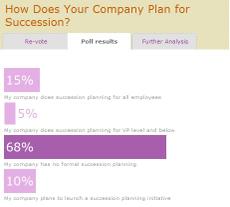
Jason's survey findings on Succession Planning show that over 2/3rd (68% to be precise) of companies today have no formal succession planning process in place.


Now does that means organizations lack sufficient talent to plan for future roles or it’s just that succession planning is not seen as a significant contributor to the HR strategy of organization today?

Micorosoft New Challenge

Last few weeks has seen some high profile exits from Microsoft including Microsoft Vista evangelist Robert Scoble .

On June 10, high-profile Microsoft Vista evangelist Robert Scoble acknowledged he had decided to leave Microsoft for startup PodTech.Net.

On June 15, Microsoft Chairman and Chief Software Architect Bill Gates announced plans to step out of his daily Microsoft duties, as of 2008. Gates passed the Chief Software Architect torch to Ray Ozzie, the creator of Lotus Notes and Groove collaboration software, effective immediately.

On June 20, Microsoft officials confirmed that Windows Live marketing chief Martin Taylor was no longer on the Microsoft payroll. Microsoft would not comment on why Taylor and his 13-year employer had parted ways so abruptly.

The latest addition to the departure list is Ted Hase, one of the four original Xbox team members and co-creator of the Microsoft Media Center PC concept.

Wednesday, June 21, 2006

Next Generation Traits for HR

Jason talks about the 6 Traits of the Next-Generation HR Leader.

Can manage complex teams of employees, partners and vendors.

Knows how his strategy (and execution of that strategy) is impacting the financial performance of the business.

Uses analytics to manage his business.

Creates a flexible work environment and is capable of managing change.

Capable of selling his strategy throughout the organization.

Understands technology and how to deliver technology to an enterprise.

XLRI to train Managers across Country

XLRI Jamshedpur has signed a memorandum of understanding with the Confederation of Indian Industry (CII) and the National Network of Human Resources Development to train managers across the country in competency management.
“Today, HR managers are in great demand, with an estimated 5,00,000 required across industries . But there exists a shortage to the tune of 40%,” Father N Casimir Raj, SJ, director of XLRI, told ET. “This apart, the attrition rate is high as people are not sure what areas they can excel in. The training has been designed to check these trends,” he added.

As part of this programme, XLRI will prepare an instrument to measure competency required for various levels of managers in different industries. This will be validated and the questionnaire administered to people to determine their strengths and weaknesses
.

Friday, June 16, 2006

Employee Benefits

McKinsey Quarterly survey findings shows that vast majority of executives say that employee benefits help their companies attract and retain talent and that benefits are important to competitiveness of a firm.

The respondents acknowledge that employee benefits have a significant impact on company finances. Sixty-three percent of the executives whose companies offerboth health care and retirement benefits view health care benefits for current employees as being more critical to a company's long-term financial health.

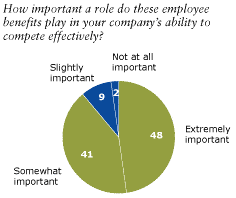
Whatever the cost of benefits, it is clear that executives think investing in them is worthwhile, even crucial. An overwhelming majority—89 percent—say that providing benefits is either "somewhat important" or "extremely important" to their company's ability to compete effectively